
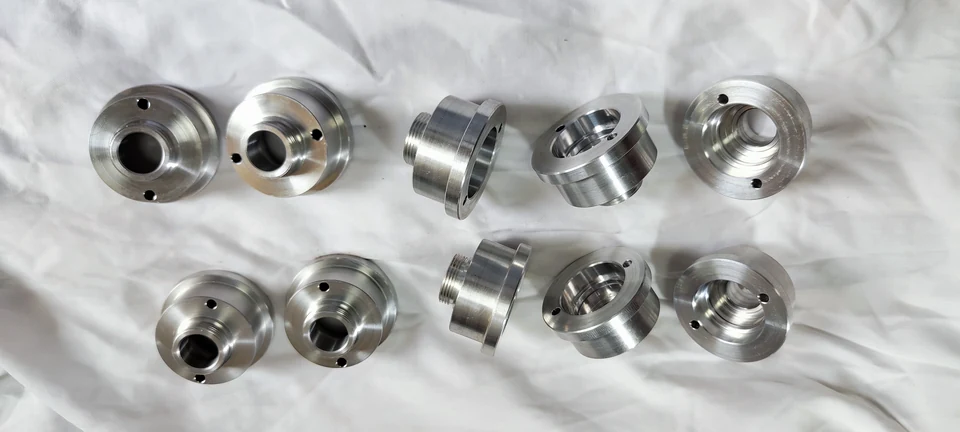
Features to define on the drawing
Bushings and sleeves are usually controlled by how they fit with another component. The important details are often the internal diameter, outside diameter, wall thickness, length, shoulder location, flange face, chamfer and surface finish. These features should be clear on the drawing before quotation.
- Internal and outside diameters
- Wall thickness, length and shoulder details
- Fit, surface finish and edge requirements
- Material and any plating or treatment requirements
- Flange, collar, groove or spacer features where required
Common applications
Turned bushings and sleeves may be used in machinery assemblies, shafts and housings, hydraulic or pneumatic equipment, agricultural and construction equipment, automation fixtures and repair parts. Some bushings act as wear components, some provide spacing or location, and others support sliding or rotating contact.
The intended use affects the most important inspection points. A sleeve used as a spacer may rely mainly on length and end-face quality, while a bushing that carries a shaft may need closer control on internal diameter, outside diameter, surface finish and material.
Materials for turned bushings
Material selection depends on the application. Brass, steel, stainless steel and aluminium are common starting points, while wear, corrosion, weight and cost should be considered before production. Brass may be useful where machinability and corrosion resistance are important. Stainless steel may suit environments where corrosion resistance matters. Steel may be selected for strength or durability, while aluminium may help reduce weight.
If the material grade is flexible, it is helpful to explain the working environment, load, movement, mating part and finish requirement. That allows the material choice to be reviewed against the function rather than selected by guesswork.
Fit and function
Bushings and sleeves often depend on how they fit with a shaft, housing or fastener. The drawing should identify whether the internal diameter, outside diameter, end face, shoulder or flange is function-critical. If a mating part is available, sharing its dimensions can help clarify the fit requirement.
For press-fit or close-fit parts, tolerance expectations should be discussed before production. Thin-wall sleeves may require extra review because clamping and machining forces can affect consistency. If the part will be plated, coated or treated after machining, the effect on fit should also be considered.
Surface finish and edge control
Surface finish can affect assembly, sliding contact and appearance. Deburring, chamfering, sharp-edge control and plating requirements should be clear before sampling. If the part has a sliding surface or sealing-related contact, the drawing should identify that surface so it can be reviewed with the correct priority.
Inspection and repeat supply
Typical inspection points include internal diameter, outside diameter, length, wall thickness, shoulder position, chamfer, burr condition and surface appearance. For recurring orders, confirmed drawings, inspection points and packing expectations help maintain batch consistency. Approved samples are useful when appearance, edge condition or surface finish are difficult to communicate by drawing alone.
What to send for a bushing or sleeve quote
Send the drawing, material grade, quantity, critical fit surfaces and finish requirements so the part can be reviewed against its intended function. Use the drawing and quotation checklist to prepare the request.
For Australian projects, include the delivery postcode and required date. Include the delivery postcode and required date so freight and timing can be reviewed with the part requirements.