
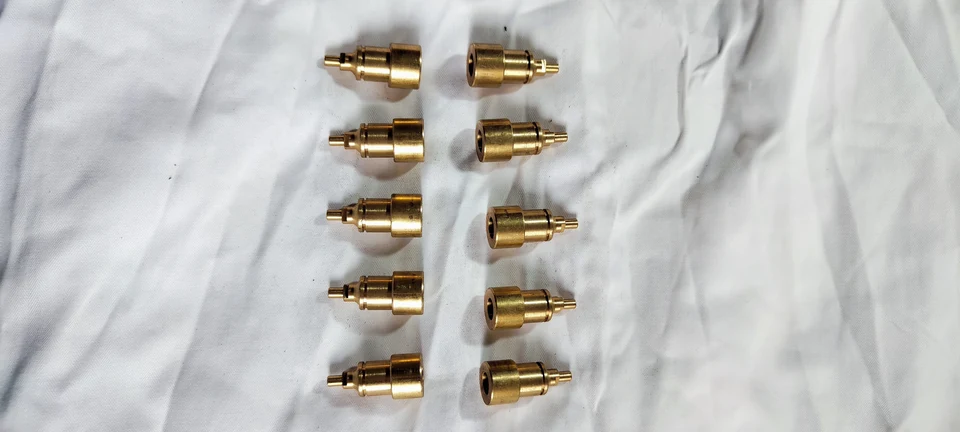
CNC turning and machining terms
- CNC Turning
- A machining process where the material rotates and cutting tools form round features such as diameters, faces, bores, grooves and threads.
- Turned Part
- A component made mainly by turning. Common examples include shafts, bushings, sleeves, pins, fittings and threaded connectors.
- Stepped Shaft
- A shaft with multiple diameters along its length. Shoulders, grooves, threads and chamfers may be used for location or assembly.
- Bushing
- A machined sleeve-like part used for spacing, guidance, wear support or fit between moving or fixed components.
- Sleeve
- A tubular turned component that may act as a spacer, liner, guide or protective part. Internal and outside diameters are often important.
- Pin
- A turned component used for location, fastening, pivoting or alignment. Pins may include grooves, threads, shoulders or chamfers.
- Bore
- An internal diameter or hole feature. Bore size, finish and tolerance can be important when a shaft or mating part fits inside.
- Outside Diameter
- The external diameter of a turned part. It is often a critical feature for shafts, sleeves, bushings and locating parts.
- Internal Diameter
- The inside diameter of a bore, sleeve or bushing. It should be clearly specified where fit or movement matters.
- Shoulder
- A step between two diameters. Shoulder location can be important for assembly, spacing or load transfer.
- Chamfer
- A small angled edge used to remove sharp corners, help assembly or improve handling.
- Groove
- A recessed feature machined into a part. Grooves may be used for clearance, retaining rings, seals or location.
- Thread Pitch
- The spacing between thread peaks. Pitch should be stated with the thread standard and size when requesting threaded parts.
- Internal Thread
- A thread machined inside a hole or bore.
- External Thread
- A thread machined on the outside of a shaft, pin, connector or fitting.
- Tolerance
- The allowed variation from a specified dimension. Tight tolerances should be reserved for functional dimensions and reviewed before quotation.
- Critical Dimension
- A dimension that affects fit, function, assembly or inspection acceptance. These should be marked clearly on the drawing.
- Surface Finish
- The condition of the machined surface, including tool marks, smoothness, appearance and any post-treatment requirement.
- Deburring
- Removing sharp burrs or unwanted edges after machining. Deburring requirements should be clear where edge condition matters.
- First-Article Inspection
- Inspection of initial completed parts before a production batch continues.
Hydraulic cylinder and shaft-related terms
Some buyers source turned parts for cylinder-style assemblies, pivots, rods or fittings. These terms help clarify drawings and part function.
- Rod / Shaft
- A linear or rotational member used to transmit force, motion or location. In cylinder assemblies, rod dimensions and surface requirements are often important.
- Piston
- A moving component inside a cylinder assembly that transmits force through a rod or related part.
- Gland
- A component at the rod end of a cylinder assembly that supports sealing and guidance around the rod.
- Clevis
- A fork-shaped connection feature with pin holes. Clevis-related parts often require accurate pin, bore and spacing dimensions.
- Pin Eye
- A male eye-style connection intended to fit between clevis plates or matching brackets.
- Base Pin
- A pin used around a base or mounting end. Diameter, length and fit should be defined on the drawing.
- Port
- A connection point for fluid or system connection in cylinder-style components. Port position can affect assembly clearance.
- Tube / Barrel
- The main cylindrical body in a cylinder-style assembly. Bore size and end features may affect mating parts.
- Stroke
- The travel distance of a moving rod or piston. Stroke affects the functional length and assembly requirement.
- Closed Length
- The measured length when a cylinder-style assembly is fully retracted.
- Open Length
- The measured length when a cylinder-style assembly is fully extended.
- Duty Cycle
- The expected operating frequency or use pattern. It can influence material, wear and inspection requirements for related parts.
How to use this glossary when requesting a quote
When sending a drawing or sample brief, use the same terms consistently. Mark critical dimensions, thread specifications, material, finish and inspection requirements. If a term is unclear, include photos or notes explaining how the part is used.